Rotation — spot the shape that's simply been turned
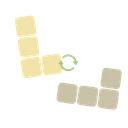
Rotation is a mental-rotation puzzle in LEVO's Spatial category. Each round shows one block figure — an amber shape built from joined squares — with four candidate pieces below it. Exactly one candidate is that same figure turned to a new angle; the rest are traps: mirror-image copies of it and a couple of unrelated shapes. Your job is to pick the true rotation and leave the flips alone. The moment you choose, the piece flies up onto the target and spins to prove itself — landing green when it truly overlays the shape and red when it's a mirror that can never fit. Rotation has 50 adaptive levels and helps improve spatial reasoning, visual recognition, and brain processing speed.

How to play
A target figure sits in a lit panel at the top under the prompt "Which piece is this, turned?", with four cream candidates in a 2×2 grid beneath it. One candidate is the target rotated a quarter, half, or three-quarter turn; the others are mirror-image impostors — a flipped copy looks almost identical but is the opposite handedness and can never be rotated to match — plus a couple of genuinely different shapes. Study the target, then tap the piece you believe is the same figure just turned. The piece you pick flies onto the target and rotates to line up, settling green if it overlays the shape exactly (a real rotation) or red if it's a flip. A correct pick scores and the next figure appears; a wrong one costs a little and shows you why. Each level is a short run of these questions against one countdown — "mirrored pieces don't count" is the standing rule.
What it helps improve
- Spatial reasoning — Deciding whether a candidate is a rotation or a reflection means turning the shape in your mind's eye before you commit — it strengthens your ability to visualize and manipulate objects in space.
- Visual recognition — You hold the target's form in mind and scan four lookalikes for the one whose pattern is genuinely the same, sharpening how quickly you identify and remember visual patterns.
- Brain processing speed — A level clock rewards reading each figure and deciding fast, round after round — accelerating how quickly your brain handles and responds to information.
Levels & progression
50 levels, complexity-based — the same adaptive model as LEVO's Memory, Focus, and Mental Math games and its Spatial siblings Architect and Origami, not a fixed numbered rail. Difficulty climbs through complexity tiers as you advance: the figures grow from small, easy-to-read blocks into larger, more intricate shapes, and the mirror decoys get harder to tell from the real rotation. Within a single level it also adapts round to round — a correct pick steps the next figure up, a miss eases it back. The pre-game screen shows a rising difficulty rank (Novice, Regular, Adept, Master, Expert), and a fixed tutorial teaches the rotation-versus-mirror distinction before your first level.
Questions & answers
How do you play Rotation?
A target shape appears at the top, with four candidate pieces below. Pick the one that is the target figure simply turned to a new angle — not flipped. Your pick flies onto the target and spins to check itself: it lands green if it's a true rotation and red if it's a mirror image.
Why don't mirrored pieces count in Rotation?
Because a mirror image is a reflection, not a rotation — it has the opposite handedness, so no amount of turning will ever lay it exactly over the original. The decoys always include at least one mirror copy that looks almost right, and telling the true turn from the flip is the whole puzzle.
How many levels does Rotation have?
50 levels. Rotation uses LEVO's adaptive complexity model rather than fixed handmade levels — the figures and decoys get harder as your rank climbs from Novice to Expert, and each level is timed. It lists three skills it helps improve: spatial reasoning, visual recognition, and brain processing speed.






Five minutes. One game.
Rotation is one of 32 brain games in LEVO — measure with an IQ test, then train daily.
Start training