Folding — picture the holes before the paper opens
Folding is a paper-folding puzzle in LEVO's Spatial games category, built on the classic fold-and-punch test — and a different game from Origami, which rebuilds a figure from loose pieces. Each question shows a square sheet being folded one to three times, then a hole punch coming down through the folded stack — and you decide what the sheet looks like once it opens flat again. Four cream paper cards offer candidate hole patterns; you pick the one you think is right, and the sheet unfolds before your eyes to prove it. Every fold mirrors the punched holes across its crease, so a single punch can open into two, four, or more. Folding has 50 adaptive levels and helps improve spatial reasoning, working memory, and visual recognition.

How to play
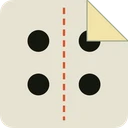
Each round reads left to right on dark panels: a strip of fold steps, then a punch step. A fold step shows the paper before that fold, a dashed crease down the middle, and a green arrow for which half swings over; the punch step shows the fully folded sheet with one or two holes bored through it. Under the prompt "Open it flat — where are the holes?" sit four paper cards, each drawn with a different pattern of holes. Tap the card you believe matches the unfolded sheet. That locks your pick and plays the reveal: the punched sheet flies to center stage and opens fold by fold, its holes doubling at every crease, then lands on your card and settles green for a match or red for a miss. The next question deals automatically. There are no lives — a wrong pick costs a little score, not the round.
What it helps improve
- Spatial reasoning — Reading the folds backwards and reflecting each punched hole across every crease is mental folding, done in your head before the reveal confirms it — it strengthens your ability to visualize and manipulate objects in space.
- Working memory — You keep the whole fold sequence and the punch positions in mind and apply them step by step — the load the game is built around, strengthening your capacity to hold and use information temporarily.
- Visual recognition — The four cards are deliberate near-lookalikes, so choosing means telling similar hole layouts apart at a glance — sharpening how quickly you identify and remember visual patterns.
Levels & progression
Complexity-based: 50 levels, each a short run of questions (about five in the early levels, down to three in the hardest) played against a single per-level countdown. Difficulty climbs across the ladder — early levels fold the sheet once and punch a single hole; the hardest fold it three times and punch twice, so the flat sheet can open into as many as sixteen holes. Within a level it also adapts question to question: a correct answer nudges the next one harder, a wrong answer eases it back toward the level's baseline. The pre-game screen shows the adaptive tier you've reached — Novice, Regular, Adept, Master, Expert — not a numbered level. A short tutorial teaches a single fold and punch, and replays the unfold on a wrong pick so you see exactly where the holes really land.
Questions & answers
What is Folding?
Folding is LEVO's take on the classic paper-folding-and-hole-punch puzzle. A square sheet is folded one to three times, a hole is punched through the folded stack, and you predict the pattern of holes that appears when the paper is opened flat again — choosing from four candidate cards. Picking one plays an unfold animation that reveals the true answer.
Is Folding timed?
Yes. Each level gives you one countdown covering its whole run of questions; if it runs out before you finish, the level ends and you can retry it. There are no lives — a wrong pick costs a little score, never the level.
How do the holes multiply?
Every fold mirrors the punched holes across its crease, so unfolding doubles them at each step: one punch through three folds opens into eight holes, and two punches into sixteen. Working that reflection out in reverse — from the folded, punched sheet back to flat — is the whole puzzle.








Five minutes. One game.
Folding is one of 32 brain games in LEVO — measure with an IQ test, then train daily.
Start training