Mirror — paint the reflection of the pattern
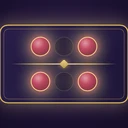
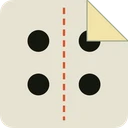
Mirror is a symmetry-completion puzzle in LEVO's Spatial category. Each card shows a pattern of jewel pips in its top half; you tap empty cells in the bottom half to place pips so they mirror that pattern across the central seam. The reflection flips top-to-bottom, not left-to-right — so a pip near the seam stays near it, and a pip at the edge lands at the far edge. When you've placed the right number of pips the card checks itself: a perfect mirror seals in gold, a mistake flashes red so you can fix it on the next card. Mirror has 50 adaptive levels and helps improve spatial reasoning, visual recognition, and precision.

How to play
Each card is a grid split by a central seam, with a pattern of coloured pips filling the top half. Your job is to complete the bottom half so it is the top's reflection across that seam — which flips the pattern top-to-bottom, leaving left and right where they are. Tap an empty cell to place a pip; tap it again to remove it. A soft colour banding tints the pips by their distance from the seam, and because the banding is symmetric a pip and its reflection share a colour — a gentle guide, never the answer. There's no Done button: the moment your pip count matches the pattern above, the card judges itself, sealing gold for a perfect mirror or flashing red for a slip. Each level is a short run of cards played against one countdown.
What it helps improve
- Spatial reasoning — Reflecting a pattern across a seam means holding each pip and its mirror position in mind at once — it strengthens your ability to visualize and manipulate objects in space.
- Visual recognition — Reading the pattern above and mapping it to its flipped counterpart sharpens how quickly you identify and remember visual patterns.
- Precision — Every pip is an exact per-cell tap with no swiping or approximation, so clean play rewards careful, accurate placement.
Levels & progression
50 levels, complexity-based — the same adaptive model as LEVO's Memory, Focus, and Mental Math games and its Spatial siblings Architect and Origami, not a fixed numbered rail. Difficulty climbs through complexity tiers as you advance: the card grid grows from a compact 3×3 to 4×4 and then 5×5, and more pips fill the pattern, so the reflections get denser and harder to hold in mind. Within a single level it also adapts card to card — seal a card cleanly and the next steps up, misjudge one and it eases back toward the level's baseline. The pre-game screen shows a rising difficulty rank (Novice, Regular, Adept, Master, Expert), and an auto-playing tutorial paints a simple 3×3 card, pointing out that reflections flip top-to-bottom, before your first real level.
Questions & answers
How do you play Mirror?
You paint the reflection of a pattern. The top half of a card shows a pattern of jewel pips; you tap empty cells on the bottom half to place pips so they mirror that pattern across the central seam. The reflection flips top-to-bottom. When you have placed the right number of pips the card checks itself — a perfect mirror seals in gold, a mistake flashes red so you can fix it on the next card.
Is Mirror timed?
Yes. Each level gives you one time budget covering its short run of cards; if it runs out before you finish, the level ends and you can retry it. There are no lives — a wrong card costs a little score and nudges the difficulty down, not the level.
How many levels does Mirror have?
50 levels. Mirror uses LEVO's adaptive complexity model rather than fixed handmade levels, and it lists three skills it helps improve: spatial reasoning, visual recognition, and precision.






Five minutes. One game.
Mirror is one of 32 brain games in LEVO — measure with an IQ test, then train daily.
Start training