
Blueprint — count every cube in the stack, hidden ones included
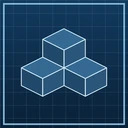
Blueprint is a 3D cube-counting puzzle in LEVO's Spatial category. Each round draws a stack of cubes on an engineering blueprint sheet — a deep-navy drafting grid, a double-line frame, dimension lines labelling the pile's width and height — rendered in solid isometric so the front cubes hide the ones behind and beneath them. Your job is to read the stack and specify the total number of units, the concealed ones included, then tap your count from four numbered keys. Every stack is built so the hidden count is a forced inference, never a guess. Blueprint has 50 adaptive levels and helps improve spatial reasoning, quantitative reasoning, and visual recognition.

How to play
A round shows one solid isometric cube stack drawn on the blueprint sheet, with the prompt "some units sit hidden — specify the total." Because the pile is drawn solid, not wireframe, the cubes in front occlude the ones tucked behind and below them, so the number you can see is never the whole answer. The stacks are built fairly: heights never rise toward you, so every column's top is visible and the hidden units underneath are something you can reason out rather than guess. Read the columns, add the units you can infer beneath them, and tap your total from the four number keys below the sheet. The moment you answer, the "component schedule" tally plays: each cube lifts off the pile front-first and flies into the schedule box while a quantity counter ticks up — hidden cubes emerging into view as the pile empties — confirming the true count unit by unit. The right key lights up, a wrong one flags amber; tap the sheet to skip the tally and move on. Each level strings several stacks together against one countdown.
What it helps improve
- Spatial reasoning — You reconstruct a solid 3D form from a single flat projection, mentally filling in the cubes the drawing hides — the core spatial-visualization move that strengthens how you visualize and manipulate objects in space.
- Quantitative reasoning — The answer is a count you build up: tally the visible column tops, add the units logically forced beneath them, and total the pile — enhancing your ability to understand and work with numerical concepts and data.
- Visual recognition — Reading the isometric stack at a glance — which faces are tops, which are stacked columns — is fast structured pattern reading that sharpens how quickly you identify and remember visual patterns.
Levels & progression
50 levels, complexity-based — the same adaptive model as LEVO's Memory, Focus, and Mental Math games and its Spatial siblings, not a fixed numbered rail. Difficulty climbs through complexity tiers as you advance: the footprint grows from a compact 3×3 grid to a 4×4, stacks get taller, and more units end up concealed, so the count you must infer gets deeper. Within a single level it also adapts round to round — read a stack correctly and the next one steps up; miss it and it eases back toward the level's baseline. Early levels run five stacks against a shorter clock; the higher levels give more time but fewer, harder drawings. An interactive tutorial teaches the trick before your first level: a small pile whose visible faces read as five but which actually totals six, because one unit hides beneath the tall column. The pre-game screen shows a rising difficulty rank (Novice, Regular, Adept, Master, Expert).
Questions & answers
How do you play Blueprint?
Each round shows a stack of cubes drawn in solid 3D on a blueprint sheet. Some cubes are hidden behind and beneath the ones in front, so you have to work out the total — visible units plus the ones concealed under the taller columns — and tap that number from four keys. A short tally then flies every cube into a schedule box to confirm the true count.
Is Blueprint timed?
Yes. Each level gives you one time budget to read all of its stacks; the harder levels allow more time but pack in taller, more-concealed piles. There are no lives — a wrong count costs a little score, not the level. Losing means the timer runs out before you finish the stacks.
How many levels does Blueprint have?
50 levels. Blueprint uses LEVO's adaptive complexity model rather than fixed handmade boards, and it lists three skills it helps improve: spatial reasoning, quantitative reasoning, and visual recognition.








Five minutes. One game.
Blueprint is one of 32 brain games in LEVO — measure with an IQ test, then train daily.
Start training