Paper Plane — flying one way, pointing another
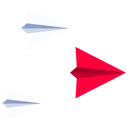
Paper Plane is a focus game in LEVO's brain-games library — and its trickiest direction test. Paper planes stream across the screen, all drifting in one flight direction while their noses point somewhere else entirely. Colour decides which of the two you answer: white planes ask for the direction they're flying; red planes ask for the direction they're pointing. Motion is the louder signal, so suppressing it on red rounds takes real concentration. Correct answers score points, wrong ones cost them, and each answer clears the sky for a new wave. Reach the score goal before the timer ends.

How to play
Each round fills the screen with paper planes of a single colour, all gliding the same way and all pointing the same way — and the two often disagree. First check the colour. White planes: answer the direction the flock is moving. Red planes: answer the direction the planes are pointing. Then swipe anywhere on the board, tap the on-screen direction pad, or press an arrow key. One answer settles the whole round: a correct one adds points, a wrong one subtracts the same amount (your score never drops below zero). The planes fade out and a new wave streams in with a fresh colour, flight direction, and pointing direction. Reach the level's score goal before the countdown ends to complete the level.
What it helps improve
- Focus — Answering the right cue while the wrong one fills the whole screen helps improve your concentration and resistance to wandering thoughts.
- Task shifting — The colour flips the rule between rounds, from "follow the motion" to "read the orientation" — it helps you switch smoothly between response rules.
- Hand-eye coordination — Converting a moving visual scene into one precise directional swipe helps refine the synchronization between visual input and hand movements.
Levels & progression
50 levels: score goals and timers scale across the run, with the adaptive tier label — Novice, Regular, Adept, Master, Expert — marking your progress.
Questions & answers
What does Paper Plane help improve?
Paper Plane lists three skills it helps improve: focus (attending to the relevant cue while a stronger one competes), task shifting (the colour rule changes what "the answer" means from round to round), and hand-eye coordination (responding with a quick, precise directional swipe).
Why is Paper Plane harder than it looks?
Because the two cues conflict. The planes’ shared motion is the most eye-catching thing on screen, but on red rounds the correct answer is where the planes point, not where they drift — and overriding the motion cue on demand is exactly the exercise.
How many levels does Paper Plane have?
50 complexity-based levels with rising score goals and time pressure, labelled with an adaptive difficulty tier from Novice through Regular, Adept, and Master to Expert.









Five minutes. One game.
Paper Plane is one of 32 brain games in LEVO — measure with an IQ test, then train daily.
Start training